
RULES OF FOUR SQUARE
Welcome to the Official Rules
Whether you're a seasoned pro or just starting out, this guide walks you through how to play, host, or judge Four Square at any level—from recess to the national championships all the way to the world championships.
📘 Table of Contents
FOUR SQUARE GAME BASICS
New to Four Square?
If this is your first time learning the game, we recommend starting with our
What Is Four Square? page —
a simple, beginner-friendly overview designed for players who are brand new.
📜 Introduction
The rules below represent the official standards used at both the Four Square National Championships™ and the Four Square World Championships™, held annually.
For those interested in alternate styles or playground adaptations, we invite you to explore the "Other Rules" section at the bottom of this page.
🔴 Equipment
Ball: An 8.5-inch rubber playground ball inflated to 2 lbs.
- Four Square requires minimal equipment, making it easy to play almost anywhere.
- Games can take place on any flat surface—chalk-drawn courts, taped-off indoor/outdoor floors, or professionally painted courts.
- Any ball that reliably bounces can be used, though a standard playground ball (8.5-inch rubber) is typically preferred for consistency and control.
🟦 Court Specifications
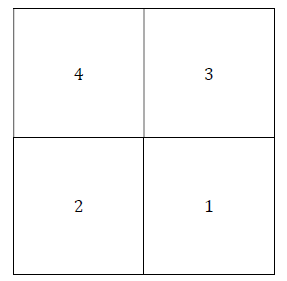
Dimensions: A 16 x 16-foot square divided into four equal 8 x 8-foot squares, numbered 1–4 with 4 and 1 diagonal from each other.
Lines:
- All court lines are 1-2 inches wide.
- Outside lines are in-bounds; a ball landing on these remains in play.
- Inside lines (dividing squares) are out-of-bounds; a ball landing on these results in an "out."
🚫 Out-of-Play Zone
To ensure fairness and promote returnable gameplay—and since overhand and closed-fist strikes are allowed where some Four Square rules allow only underhand hits—an Out-of-Play Zone is used to discourage unreturnable shots and to ensure safety for all.
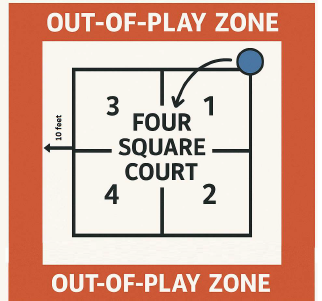
- The Out-of-Play Zone extends 10 feet beyond each boundary line of the Four Square court.
- If a ball is legally hit into another player’s square and then bounces and lands into the Out-of-Play Zone, the player who struck the ball is out.
- The out-of-play zone line is in-play.
- This rule is designed to encourage all hits to maintain a level of reasonable and possible returnability. This also encourages safety for competitors and spectators.
🧍 Objective
Be the last player standing! The goal is to be the last player remaining after all other players have been eliminated. When play begins, each square contains a player along with the players waiting in line. The player in square 4 serves the ball to square 1 who then hits the ball into a square other than their own. The hits go on until someone gets “out”.
👣 Player Positioning
- Players may move freely but must not interfere with other players’ ability to play the ball.
🤲 Serving
- The server (in Square 4) must be within the back-half or outside of Square 4.
- The serve must be made underhand.
- The server must bounce the ball once and then hit it with one or both hands into Square 1.
- The serve must be non-aggressive at a reasonable speed, with standard rotation, and must not rise above head height at any point as serves are meant to place the ball fairly into play.
-
The receiving player (Square 1) is allowed one do-over by calling “one bad”
- The receiving player may announce “one bad” before hitting the ball or after hitting the ball if it resulted in an out.
- If the serve is illegal/results in an out (e.g., lands outside Square 1, hits an interior line), the server is allowed one "one bad".
🖐️ Ball Striking/Hitting
- Only hands and wrists may strike the ball. “Hands” are defined as the area from the wrist to the fingertips, including the backs of the hands.
- The ball may be struck with one or both hands, using either open palms or closed fists, as long as it is one deliberate and clean hit.
- No carrying, catching, holding, or double-hits are allowed at any time.
- Other than the serve, spinning the ball is allowed as long as the hit that produces the spin is not a carry or other illegal hit.
- Kids' divisions require a bounce before hitting (no air balls).
- Any player who strikes the ball illegally is considered out.
⚠️ Interference & Poaching
- Once the ball bounces in a square, only that player may hit it.
- If the ball bounces in a square and another player makes contact with the ball (deliberately or not), and the player whose square the ball bounced in makes an attempt to play the ball and had a realistic chance of getting it, the player who made contact with the ball is out.
- If the player whose square the ball bounced in does not make a legitimate attempt to play the ball and another player makes contact with the ball (deliberate or not), the player whose square the ball bounced in is “out”.
- Boys + Girls/Children’s Divisions: The ball must bounce in a square for a player to hit the ball (no air balls).
- Players are not able to physically impede another player from the ball. Impeding another player from getting the ball is another form of “interference” and results in an out.
❌ Elimination
Each time a player is out, that player leaves the court and enters the line and, if applicable, all players advance to the higher numbered square. Square 1 is then filled with a new player.
Ways to get out:
- Ball bounces more than once in your square.
- Hitting the ball out-of-bounds, the inside lines, your own square or the out-of-play zone.
- Carrying, poaching, interfering.
- Ball hits you not in hands.
🏟️ Environment
- If the ball bounces in a square and an obstacle impedes the player from returning the ball (e.g., person, chair, object):
- If the player made an attempt and had a realistic chance of legally returning the ball, the round is declared “dead” and will restart.
- If the player did not attempt or had no realistic chance of returning the ball, that player is out.
⚔️ Showdown
Disputes? Lets have the Four Square Gods settle it with a 1-on-1 showdown using just 2 squares. Higher square serves.
⛔ Prohibited Moves
- Blackjack: Catching the ball outside the squares.
- Spinzies: Using two hands to spin.
- Short-stopping: Hitting ball to self.
- Body Parts/Language: Using body parts other than hands.
👥 Divisions
- Boys 14 & under
- Girls 14 & under
- Men 15+ with Sub-division: Senior Men 45+
- Women 15+ with Sub-division: Senior Women 45+
🏆 Tournament Structure
Round 1:
Kids Divisions (Boys + Girls) play together; Adults Divisions (Men + Women)
play together.
45 minutes of play across multiple courts.
Each "out" is tallied.
Round 2 (Semifinals):
Players return to where they left off in Round 1 — 25 minutes of play.
Kids Divisions (Boys + Girls) play together; Adults Divisions (Men + Women)
play together.
“Outs” continue/carry-over from Round 1.
Top 8 players/least amount of 'outs' per division advance.
(if ties occur: all tied competitors advance)
Championship Round:
Finalists compete in a “10-out” untimed tournament.
Pick-from-hat method to determine where players begin in squares/lines.
Square 2 is vacated when 3 players left.
When two remaining players: 1v1 in adjacent squares.
Last player standing is crowned champion.